


Disclaimer
This article explains how British Virgin Islands trusts are formed, run and reported. It is not legal, tax or accounting advice. Rules change, and your facts are your own. Speak to a qualified adviser before you act.
BVI TRUSTS IN 2026: NEW REPORTING RULES FOR TRUSTEES
For years, setting up BVI trusts worked like this: You’d sign a deed, and a trustee would hold your shares. The British Virgins Islands had no general public trust register. On paper, BVI still has no trust register. In practice, however, that does not mean there is nothing to report. Other reporting obligations may still apply.
On 10 December 2024, a new rule took effect. Now, every trustee of a BVI trust must collect, verify and keep information about the people behind the trust. This includes the person who set up the trust, anyone who can benefit from it, and anyone who controls it. However, the trustee does not file this information with a registry. Instead, they must keep it up to date and provide it to the relevant authority when asked. A trustee who ignores this faces a fine of up to $75,000.
Three weeks later, on 2 January 2025, a second rule started. Any BVI company sitting under that trust must file its own beneficial ownership details with the Registry, although exemptions may still apply. Who has to file, and how much they file, depends on who holds its shares as trustee and whether the legal conditions are met. That choice matters because it affects the company’s reporting duties. This shall be explained in Chapter VIII.
This guide explains how BVI trusts work, who is responsible for what, and how VISTA trusts work in practice. It also covers what creditors can reach, what your home country may still tax, and the fines the BVI regulator has imposed on trustees.
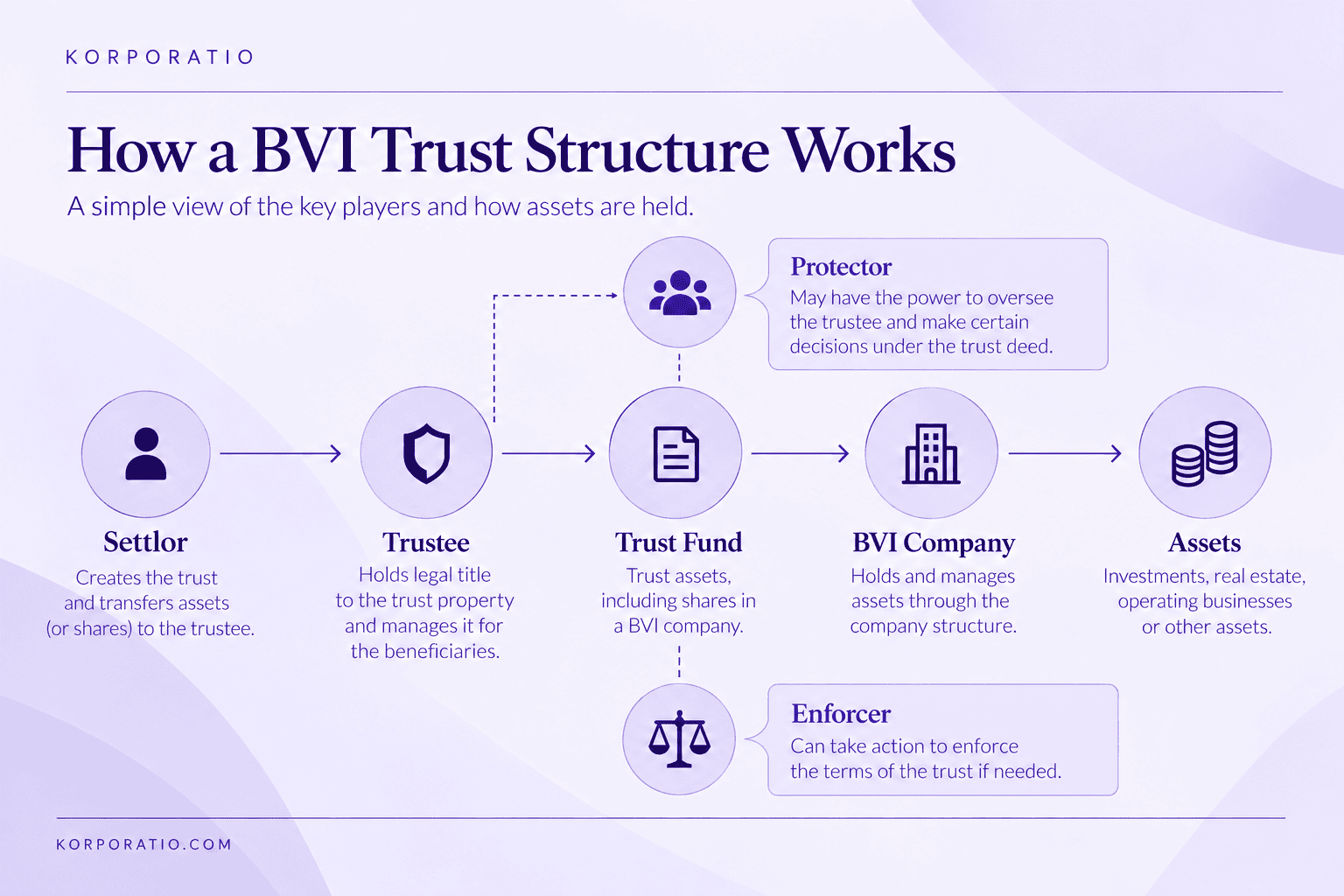
I. WHAT A BVI TRUST IS AND HOW IT WORKS
A company and a trust serve different purposes. One one hand, a company owns assets in its own name and has shares. If you hold those shares, you own the company, and your name appears in its ownership records.
On the other hand, a trust works differently. It is not a legal person and does not own assets in its own name. When you create a BVI trust, you transfer legal title to the assets to a trustee. The trustee’s name then appears on the share register, bank mandate or title deed. As such, you no longer hold legal title to those assets. Instead, the beneficiaries receive rights under the trust, such as the right to benefit from the trust or, depending on its terms, to receive distributions.
That split is the whole point. One person holds legal title, while another has the benefit of the assets. Because you no longer hold legal title, the assets do not normally pass through your estate when you die. Additionally, a personal claim against you also does not automatically give the claimant a right to the trust assets.
The Trade-Off: You Keep Some Powers, Not Full Control
You give up direct control over the trust assets. However, BVI law does allow the trust deed to reserve certain powers to the settlor or another person. Chapter IV explains which powers can be retained. But the fact remains: the trustee decides, and you do not. Nevertheless, the trustee must still act within the powers and duties set by the trust deed and applicable law.
Note: A BVI trust is not a company, and it is not an alternative to one. They are often used together. The trust can hold the shares in a BVI company, while the company holds the underlying business or investments. Each serves a different purpose.
Registration, Duty and Privacy
The BVI keeps no public register of trusts. In fact, your trust deed remains a private document. According to Harneys, trust duty of US$200 is payable on the deed that establishes a BVI trust, paid by affixing a stamp.
However, privacy at the trust level does not mean privacy everywhere. The trustee holds a record of who you are, and since December 2024 the law requires it. The company underneath files its own details. Your bank may also report information under the Common Reporting Standard, depending on your account and tax status. Chapters VIII and IX deal with each of these.
II. WHO DOES WHAT INSIDE A BVI TRUST
Three roles are central to an ordinary trust: the settlor, trustee and beneficiary. Depending on the structure, you may also have a protector or an enforcer. Each role carries different powers, duties and reporting implications.
Who Holds the Trustee Accountable?
Imagine you set up a trust to hold shares in a private trust company. The trust has a specific purpose, but no beneficiaries who can hold the trustee to account in the usual way. So who steps in if the trustee fails to follow that purpose?
The enforcer. Under BVI law, a non-charitable purpose trust must have an enforcer whose role is to enforce its purpose. The enforcer is not just a name in the trust deed: the role carries legal duties and powers. The trustee and enforcer must also be different people.
But here’s the detail worth thinking about when drafting the deed: what happens if your enforcer resigns or can no longer act? Without a workable replacement process, a role designed to keep the trust on track can become a source of delay and uncertainty.
BVI Purpose Trusts: Designated Trustees and Enforcers
The BVI lets you create a trust with no beneficiaries at all. In fact, sections 84 and 84A of the Trustee Act allow a non-charitable purpose trust, which exists to carry out a stated purpose rather than to benefit a person. Section 84 covers trusts made before 1 March 2004. Section 84A covers everything after.
These trusts carry two requirements that a normal BVI trust does not.
First, at least one trustee must be a designated person. This can be a BVI lawyer, a qualifying BVI accountant, a licensed trust company, or a BVI private trust company. The trust must always have at least one designated person acting as trustee. If that person stops acting, a replacement must be appointed. If no replacement is appointed, the court can step in.
Second, there must be an enforcer, who holds both the power and the duty to enforce the trust. Their job is to make sure the trustee follows the trust’s purpose. The same person cannot be both the trustee and the enforcer at the same time. If the position becomes vacant, the law sets out a process for appointing a replacement, which can involve the Attorney General and the court.
Practical note.
What if you want to keep an aircraft within a long-term ownership structure, or hold the shares of a private trust company without naming individual beneficiaries? A purpose trust can help. Instead of holding assets for specific people, the trustee holds them to serve a stated purpose. The trustee must follow the trust deed and BVI law.
And because section 84A allows these trusts to continue without a fixed end date, they can support structures designed to last for generations. However, the trust deed can still set a date or event for termination and explain how the assets should be distributed when the trust ends.
III. VISTA TRUSTS: THE REASON FOUNDERS PICK BVI
Here is the problem VISTA solves. You built a business, you put the shares into a trust, and your trustee holds those shares. Now, a trustee has a duty to look after the value of what it holds. So the trustee starts asking questions: Why is the company carrying that much debt? Why has it not paid a dividend in four years? Should those directors still be in post?
Under ordinary trust law the trustee is right to ask. If the company loses value and the trustee did nothing, the beneficiaries could sue the trustee. So professional trustees interfere, because not interfering is how they get sued.
The Virgin Islands Special Trusts Act 2003, known as VISTA, switches that duty off. It is a separate statute from the Trustee Act, and it applies only when you direct that it should.
What the Act Actually Says
The wording matters here, so it is worth reading the operative parts of the Act itself, published by the BVI Financial Services Commission.
Section 5(1) says the designated shares are held “on trust to retain them”. Section 5(2) then says that duty to retain “shall have precedence over any duty to preserve or enhance the value of the trust fund.
Here’s the part worth paying attention to: even if the shares lose value, the trustee’s duty to keep holding them takes priority over the duty to protect the trust fund’s value.
Section 6(2) says trustee powers must not be exercised “so as to interfere in the management or conduct of any business of the company”. Then, section 6(3) goes further: the trustee must take no steps to instigate or support action against the directors, and no steps to procure their appointment or removal.
In addition, section 7 lets you write office of director rules into the trust deed. In other words, it lets you decide who gets a seat at the table when it comes to running the company. Through the trust deed, you can require a named person to serve as a director, set when directors must be appointed or removed, and decide how many directors the company must have. You can also give a named person or committee a say in these decisions by requiring the trustee to follow their directions.
Case Study: What Happens if a BVI Company’s Sole Director Dies?
You own a BVI company. You are its sole director, and your children are meant to benefit from the shares held in trust. Then you die unexpectedly. The trustee still holds the shares, but who appoints the next director? And what happens if the family cannot agree on who should take over?
VISTA lets you address that problem before it happens. Under section 7 of the Virgin Islands Special Trusts Act 2003, the trust deed can set rules for appointing and removing directors. For example, it can require a named person to take office or give a named person or committee a role in those decisions.
That way, you can plan who takes the reins instead of leaving the question unanswered until a crisis hits. The rules must still work with the company’s articles and applicable BVI company law. A VISTA trust does not, by itself, guarantee that a replacement director can be appointed without difficulty.
The Four Conditions |
|
|---|---|
| Condition | Detail |
| A VISTA direction in the deed | Section 4(1) lets you apply VISTA to all BVI shares in the trust fund, or only to named ones. |
| A designated trustee | Section 4(4)(b). Must be a holder of a trust licence under the Banks and Trust Companies Act, or an exempt private trust company. |
| BVI company shares only | Shares on the BVI Business Companies Register. Regulated entities are excluded, including banks, insurers, SIBA licensees, company managers and money services businesses. |
| Trustee separate from the board | The point of VISTA is disengagement, so the trustee does not sit as director of the company it holds. |
⚠️ The VISTA Trap
Section 8 lets an “interested person” call on the trustee to intervene in the company, but only on a permitted ground. Section 8(2) then says a trust instrument “may specify one or more permitted grounds for complaint, but need not specify any.”
Suppose your deed specifies none. Section 6 bars the trustee from acting on its own. Under Section 8, your family has no ground to make it act. Section 5(2) then tells the trustee that holding the shares takes priority over protecting their value.
Consequently, if you set up a VISTA trust, check which grounds for intervention your deed allows. Otherwise, the trustee may have very limited options when the company gets into trouble. The aim is to keep the trustee out of day-to-day management without leaving the family with no clear route to seek intervention when it is needed.
Interested persons under section 2(1) include a beneficiary, an object of a discretionary power, the parent or guardian of a minor beneficiary, an enforcer under section 84A of the Trustee Act, a protector unless the deed says otherwise, an appointed enquirer, and anyone else the deed designates.
When Does a VISTA Trust Make Sense?
What happens to your business and your family if you die or can no longer make decisions for yourself? It is not an easy question, but it is one worth planning for.
Conyers describes a case involving a parent with a disabled child. The parent wanted to make sure the child would be cared for if the parent died or lost the ability to make decisions. The VISTA trust was designed to keep control in the parent’s hands during their lifetime, while allowing the arrangements to change if either event occurred. The trustee could then take a more active role in managing the investments to provide for the child.
The lesson is simple: plan for what happens when you can no longer take care of things yourself. A VISTA trust can help you set out in advance how the shares should be held and how the arrangements should work if your circumstances change.
Why Your VISTA Trust Deed Matters: The Limits on Trustee Power
However, VISTA does not give the trustee unlimited power to act. The trust deed must set out how the arrangement should work, including who can serve as a director and when the trustee may be asked to intervene.
For example, if the company runs into serious trouble, the trustee cannot simply step in and replace the directors because it believes they are making poor decisions. Any intervention must follow the rules set by the Act and the trust deed.
That is why the wording of the trust deed matters. You need to decide in advance who should run the company, what should happen if you die or lose capacity, and when someone should be able to ask the trustee to act. Otherwise, the structure may not work as you intended when your family needs it most.
IV. RESERVED POWERS: HOW MUCH YOU CAN KEEP
When you set up a BVI trust, you transfer assets, such as company shares or investments, to a trustee to hold for your beneficiaries. However, transferring your assets does not always mean giving up every decision-making power. Under section 86 of the BVI Trustee Act, you can reserve certain powers for yourself or give them to another person without invalidating the trust for that reason alone.
For example, you may want to keep the power to appoint or remove a trustee, change the beneficiaries, or direct how certain trust assets are handled. To make this work, the trust deed must clearly state which powers you keep, who can exercise them, and what each power allows. That way, everyone knows where your authority begins and ends, rather than assuming that keeping one power gives you control over the entire trust.
Section 86 of the Trustee Act, as amended by the Trustee (Amendment) Act 2021 (No. 12 of 2021), says that reserving or granting these powers “shall not (a) invalidate the trust; (b) prevent the trust taking effect according to its terms; or (c) cause any of the trust property to be part of the estate of the settlor.”
Clearly, this gives the BVI considerable flexibility when drafting a trust deed. However, it does not mean that every exercise of a reserved power is valid. The power must still be exercised within the limits of the trust deed and the law that applies.
What the list in the Act covers
01 · REVOCATION
Power to revoke the trust in whole or in part.
02 · AMENDMENTS
Power to vary or amend the terms of the trust instrument.
03 · TRUST PROPERTY
A general, intermediate or special power to advance, appoint, pay, apply, distribute or transfer trust property.
04 · COMPANY CONTROL
Power to act as, or give binding directions on the appointment or removal of, a director or officer of any company wholly or partly owned by the trust.
05 · ASSET DECISIONS
Power to give binding directions on the purchase, retention, holding or sale of trust property.
06 · OFFICE HOLDERS
Power to appoint, add, remove or replace any trustee, protector, enforcer or other office holder.
07 · BENEFICIARIES
Power to add, remove or exclude any beneficiary, class of beneficiaries or purpose.
08 · GOVERNING LAW
Power to change the proper law of the trust.
09 · COURT JURISDICTION
Power to change which courts have jurisdiction.
10 · TRUSTEE POWERS
Power to restrict the exercise of a trustee’s powers, discretions or functions.
The 2021 changes also matter if you already have a BVI trust. Harneys notes that the 2021 expansion applies to existing BVI trusts as well as new ones. If your trust was set up before 2021, ask your trustee or adviser to review the deed and check whether its reserved powers still reflect your intentions
⚠️ BVI law is not the only law that judges your trust.
Section 86 stops a BVI court invalidating your trust because you kept power, but it does nothing about your home country. In reality, the tax consequences depend on the laws of the country where you live and how those laws treat your trust. For example, the tax rules may depend on your tax residence, the assets held in the trust, the terms of the trust deed and the powers you keep.
So, before you reserve any powers, ask a tax adviser in your country to check how they could affect you. A trust may be valid under BVI law, but that does not mean your home country will treat it the same way.
A Broad Power Still Has Limits
In Grand View Private Trust Co Ltd v Wong [2022] UKPC 47, the trustee of a Bermudian family trust used its powers to remove the settlors’ descendants as beneficiaries and make the trustee of a separate purpose trust the sole object of the original trust. The Privy Council held that the decisions had been made for an improper purpose
The case shows why broad wording in a trust deed does not give a trustee unlimited freedom. A court may ask two questions:
-
Did the deed allow the trustee to make that decision?
-
Did the trustee use the power for a proper purpose?
Both questions are separated because a power may be broad enough to cover a decision on its wording; yet its exercise may still be improper.
Although the appeal came from Bermuda, the decision remains highly relevant to BVI trusts: it’s an important Privy Council decision on common-law trust principles. For a BVI trust, it is a useful warning when drafting powers to add or exclude beneficiaries, amend the trust, or redirect its assets. Thus, the deed should make the intended purpose and limits of those powers clear. Mourant reads the case as a warning to seek the court’s blessing before any momentous decision.
V. CREDITORS AND TRANSFERS TO TRUST
Offshore trusts are often promoted as a way to protect wealth from creditors. However, a BVI trust does not make assets untouchable.
Under section 81(1) of the Conveyancing and Law of Property Act 1961, a person prejudiced by a transfer made with intent to defraud creditors can ask the court to set it aside. As a result, moving assets into a trust does not prevent a creditor from challenging the transfer. What matters is the purpose behind the transfer, the evidence available and the circumstances of the case.
What a Creditor Must Prove
According to Conyers, the creditor must show an intent to defraud and the prejudice caused by it. There is no need to prove actual deceit, but there must be “some element of dishonesty” or sharp practice.
The claim does not succeed simply because the settlor transferred assets into a trust. However, if the court finds that the legal test is met, the transfer may be set aside. The consequences depend on the transaction and the relief the court grants. Additionally, section 81 protects certain later transfers made for valuable consideration and in good faith, where the recipient had no notice of the intent to defraud.
The Six-Year Period Is Not the Shield It Looks Like
An action cannot be brought more than six years after the cause of action accrued. Under section 25 of the Limitation Ordinance, though, that period does not start until the claimant discovered the fraud, or could have discovered it with reasonable diligence.
So the clock does not necessarily start when you sign the deed; it starts when the claimant discovers the fraud, or could have discovered it with reasonable diligence. If a creditor only discovers the fraud in year nine and could not reasonably have found it earlier, the six-year period can run from then.
The BVI case Bigler v Blettner, Civil Suit No 197 of 1993, is also relevant to how section 81 claims can apply to a transaction that prejudices creditors. In this instance, the BVI High Court considered a transaction involving a company’s principal asset while creditors remained unpaid. However, whether a transfer can be challenged depends on the evidence and the facts of the particular case.
⚠️ Choose the BVI for the right reason.
A BVI trust can help with succession planning and the long-term management of family wealth. However, it should not be treated as a way to defeat creditors.
If you already face a claim, expect a lawsuit or have debts you may struggle to pay, get legal advice before transferring assets into a trust. The timing of the transfer, your financial position and the reasons for making it may all matter. If the transfer was made with intent to defraud creditors, section 81 may allow it to be challenged.
In short, plan ahead, keep clear records and do not assume that moving assets into a trust puts them beyond a creditor’s reach.
VI. FORCED HEIRSHIP AND THE BVI FIREWALL
Some countries protect the inheritance rights of close family members. For example, forced-heirship rules may reserve part of an estate for children or a spouse, even if a will says otherwise. The exact rules depend on the country.
This can create a problem for a founder who wants to pass wealth to chosen beneficiaries through a trust. As a matter of fact, a family member may argue that the transfer conflicts with their inheritance rights under local law.
As it happens, the BVI has a legal safeguard for this situation: its trust firewall. Section 83A of the Trustee Act limits when foreign inheritance rules can affect a BVI-law trust. Then, the 2021 amendments strengthened that protection. However, the firewall does not bind every foreign court, so where the family lives and where the trust assets are held still matter.
What Section 83A Protects
Section 83A of the BVI Trustee Act is designed to stop certain foreign laws from undermining a BVI-law trust. It covers more than forced heirship.
- First, the firewall addresses foreign laws that do not recognise trusts. A trust governed by BVI law is not invalid simply because another country does not recognize the trust concept.
- Second, it protects against certain claims based on family relationships. For example, a person may claim rights over trust property because they are related to the settlor or a beneficiary. Section 83A limits the effect of those foreign-law claims in the BVI.
- Third, the firewall affects how the BVI treats foreign court judgments. Under section 83A, a foreign judgment cannot be recognized or enforced in the BVI to the extent that it conflicts with the protections set out in the section. The Act specifically addresses foreign judgments that vary a BVI trust without the consent of the adult beneficiaries who have legal capacity.
A Recent Example: Iraqi Law and BVI Shares
Additionally, section 83A deals with cases where foreign law does not recognise trusts at all. To be precise, the BVI High Court confirmed this point in 2026 in NMH & ATG v PWP & NKT. The dispute involved shares in a BVI company and an argument that Iraqi law should govern the alleged trust. Because Iraqi law does not recognize trusts in the same way as BVI law, the defendant argued that no enforceable trust interest could arise.
The court rejected that argument at this stage of the proceedings. It held that BVI law governed the essential validity of the alleged trust of the BVI company shares under section 83A. However, the court did not decide that the trust existed. That question remained separate.
The practical lesson is narrow but important: where the alleged trust property consists of shares in a BVI company, a party cannot defeat the claim simply by arguing that the law of another country does not recognise trusts.
Beyond that, the 2021 amendment also widened the firewall’s reach. It now addresses certain foreign-law claims based on a personal relationship with either the settlor or a beneficiary. This matters because a challenge may come from someone connected to a beneficiary, not just from someone related to the person who created the trust.
Where the Firewall Stops
Two limits matter in practice.
The first limit is geographic.
The BVI firewall governs how BVI law treats foreign laws and judgments. It does not require a French, Spanish or other foreign court to reach the same result.
For example, a family member may bring a réserve héréditaire (forced-heirship) claim in France. The French court would decide whether it has jurisdiction, which law applies and what relief is available. If the claimant obtains a judgment, the next question is whether and where that judgment can be enforced. Assets held outside the BVI may face different risks from assets held within it.
Therefore, if you live abroad or hold assets in several countries, do not rely on the BVI firewall alone. Get advice on the law of the countries where you live, where your family members may bring claims, and where the trust assets are held.
The second is contractual.
Section 83A allows for an express provision in the trust or disposition that changes how the firewall applies. As a result, the deed’s wording matters.
If you already have a BVI trust, ask your trustee or lawyer to check whether the deed contains any provision that limits or excludes the firewall’s protection. If you are setting up a new trust, make sure the deed reflects the protection you expect it to provide.

VII. HOW LONG A BVI TRUST LASTS, AND HOW TO CHANGE IT
How Long Can a BVI Trust Last?
A BVI trust can last for generations, but the law sets limits on how long certain interests can remain unvested. This is known as the rule against perpetuities.
For trusts created under instruments taking effect after 15 May 2013, the trust deed can set a perpetuity period of up to 360 years. Earlier trusts are generally subject to the former 100-year limit. However, the trust deed may set a shorter period, so check its terms rather than assuming the trust can last for the full 360 years.
The BVI also follows a “wait and see†rule. This means a trust interest is not invalid just because it might pass to someone too late. Instead, the law waits to see whether it becomes clear that the interest will vest after the permitted period.
There is also an important exception. In reality, the rule against perpetuities does not apply to charitable or non-charitable purpose trusts. As a result, these trusts can continue beyond the time limits that apply to ordinary private trusts.
Changing a Trust: Section 58B and Its Catch
Family circumstances and tax rules can change long after a trust is created. For that reason, the BVI added section 58B to the Trustee Act in 2021. It gives the court power to change a trust’s terms, including who benefits from it, even where the change may adversely affect someone.
However, section 58B does not apply to every BVI trust. A trust created on or after 9 July 2021 must expressly opt in through its trust instrument. An older trust governed by another country’s law may also qualify if its governing law is changed to BVI law and the required instrument expressly opts in.
The court must still decide that the proposed change is expedient in the circumstances. It must also consider the factors set out in section 58B where they are relevant. In addition, the section does not allow an order to affect an interest that has already vested absolutely and indefeasibly in possession.
As a result, section 58B can provide a way to update a trust when circumstances change, but it is not a shortcut around the trust deed or the court’s requirements. If you want this option, check that the deed includes the required wording before you rely on it.
⚠️ Section 58B is opt-in only.
Per O’Neal Webster, it applies to trusts created after the 2021 Act took effect where the trust instrument expressly says so, and to foreign trusts that move to BVI law where the change-of-law document expressly says so. An existing BVI trust with no opt-in wording cannot use section 58B. If your deed predates July 2021, check whether it expressly opts into section 58B.
Section 59A puts the Hastings-Bass rule into BVI law. It lets the court set aside a fiduciary decision where the decision-maker ignored something relevant or took account of something irrelevant, and that mistake affected the decision.
Practical note.
The BVI does not have a US-style statutory decanting regime where a trustee can simply move the assets into a new trust with different terms. Changes can instead come through the trust deed’s own powers, reserved powers (Chapter IV), or the court’s statutory variation powers.
If you want section 58B flexibility, build it into the deed from the start. Adding it later may require a court application or another valid power under the trust deed.
VIII. BVI TRUSTS, PRIVATE TRUST COMPANIES AND REPORTING
The choice of trustee also affects the company’s reporting duties.
What a Private Trust Company Is
Instead of appointing a bank or licensed trust company, a family can form its own company to act as trustee. That is a private trust company, or PTC. Family members can sit on its board, so the family can keep a much closer role in how the trustee is run.
Mourant sets out the conditions under the Financial Services (Exemptions) Regulations 2007. The PTC must be set up in the BVI, and its memorandum must say that it is a PTC. Its name must include (PTC) before the corporate suffix. It can only carry on related or unremunerated trust business. Its registered agent must hold a Class I trust licence, and the PTC cannot offer trust services to the public. The initial registration fee is USD 1,500, followed by an annual fee of USD 1,500.
Related trust business means that every beneficiary is the settlor, someone connected to the settlor, or a charity. Unremunerated trust business means the PTC and its associated people do not get paid for providing the trust services, apart from certain director fees.
How the Reporting Rules Change
On 2 January 2025 the beneficial ownership regime for BVI companies took effect, under the BVI Business Companies (Amendment) Act 2024 and the Business Companies and Limited Partnerships (Beneficial Ownership) Regulations 2024. For a new BVI company, the registered agent must file the beneficial ownership information through VIRRGIN within 30 days of incorporation. The information must also be kept accurate and up to date when it changes.
This is where your choice of trustee matters. If a BVI company is held through a trust, it may qualify for a reporting exemption if its trustee is licensed under the Banks and Trust Companies Act and meets the legal conditions. If the exemption applies, the company may file less information about the people behind the trust. However, a private trust company (PTC) does not qualify for this exemption just because it can provide trust services without a full trust licence. The company must still check whether another exemption applies and meet all the relevant conditions.
One recent change is worth noting. The beneficial ownership rules were amended on 29 December 2025. The changes affect when a company can lose its exemption, including where its shares are held by a licensed or foreign regulated trustee. So, the exemption is not permanent. The company must keep meeting the rules for it to apply.
Then the regime splits, and your choice of trustee decides which side you land on.
| Your trustee | What gets filed with the Registry | What you trade |
|---|---|---|
| Licensed trustee
under the Banks and Trust Companies Act |
Exempt from filing settlor, protector and beneficiary names, if the trustee holds the information, its name is filed with the Registrar, and it can produce the information within 24 hours. | You give up day-to-day control of the trustee to a regulated third party. |
| Private trust company | No exemption. The relevant beneficial ownership information must be filed. | You keep control of the trustee and file your family’s details instead. |
| Unregulated trustee | No exemption. Must file. | Same exposure as a PTC, with none of a PTC’s structure. |
The trade-off: A PTC qualifies as a VISTA designated trustee, so it keeps control inside the family. The same choice forfeits the licensed-trustee filing exemption, so the family’s details go to the Registry. Control and reduced filing are not available together. Decide which one you actually want before you form the PTC, because reversing the decision means changing trustee.
BVI reporting and CRS are two different things.
If your BVI company qualifies for the licensed-trustee reporting route, it may be able to name its licensed trustee in its BVI filing instead of reporting the usual individual beneficial ownership details.
However, this does not mean your identity is hidden from the trustee or exempt from tax reporting. CRS has its own rules. Depending on how your trust or company is classified, you and other people linked to the trust may still need to be reported to the BVI International Tax Authority.
Before you set up the structure, ask two separate questions: What information must the company file in the BVI, and who must be reported under CRS? Ask your trustee to explain both, including whether your details could be sent to the tax authority in your country of tax residence.
Who Can See the Register
The BVI does not have a public beneficial ownership register. Since 1 April 2026, someone can ask for access only if they can show a legitimate interest. This can include certain AML checks and investigations into money laundering, terrorist financing or proliferation financing.
The timeline is straightforward. The beneficial ownership rules took effect on 2 January 2025. They were amended on 1 July 2025. Applications for exemptions opened on 2 January 2026, and the legitimate-interest system went live on 1 April 2026.
If access is granted, the information available is limited. It covers beneficial owners with 25% or more ownership or control. The information includes their name, nationality, month and year of birth, and the nature and extent of their interest. The company is notified of the request and has five days to object.
A beneficial owner can also apply for an exemption from disclosure. The rules cover cases such as serious risk, national security, vulnerable persons and certain public-interest grounds.
The Duty on Your Trustee
The company rules are only part of the picture. BVI trustees have their own duties.
The Trustee (Amendment) Act 2024 came into force on 10 December 2024 and added section 92B to the Trustee Act.
Under section 92B, trustees must collect and keep adequate, accurate and up-to-date information about the people behind the trust. They must take reasonable steps to check that information and update it within 30 days of becoming aware of a change. They must also keep the records for at least five years after the trust ends.
A trustee who fails to comply without a reasonable excuse can face a fine of up to US$75,000.
None of this means the trustee files the information on a public trust register. The trustee keeps the records and must provide them to the relevant authority when the law requires it.
Enforcement in Practice
The BVI Financial Services Commission publishes its enforcement actions. Recent penalties against trustee businesses include:
| Date | Entity | Penalty |
|---|---|---|
| 1 May 2026 | SHRM Trustees (BVI) Limited | $175,000 plus warning letters |
| 21 November 2025 | Aleman, Cordero, Galindo & Lee Trust (BVI) Limited | $125,000 |
| 30 September 2024 | Vistra (BVI) Limited | $219,000 plus warning letters |
| 30 September 2024 | Vistra Trust (BVI) Limited | $57,500 plus warning letters |
Those are established firms, not shell operators. If a trustee has an enforcement record, check what the breach involved, how serious it was, and what action followed.
IX. BVI TRUST REPORTING: ECONOMIC SUBSTANCE, CRS AND FATCA
Economic Substance Does Not Apply to Your Trust
Carey Olsen states plainly that the substance legislation “does not apply to trusts or general partnerships”. The Economic Substance (Companies and Limited Partnerships) Act 2018 covers companies and limited partnerships. A trust is neither.
The BVI company underneath your trust is a different matter. If it carries on one of the nine relevant activities, such as banking, insurance, fund management, finance and leasing, headquarters, shipping, holding, intellectual property, or distribution and service centre business, it may have to meet the substance requirements and file. The declaration is due within six months of the end of its financial period. Penalties run up to US$400,000.
Note.
“holding business” is a relevant activity. A BVI company whose only job is to hold shares for your trust is likely doing exactly that. The substance test for pure holding companies is lighter than for the other categories, but it is not zero, and the filing is not optional.
CRS: Which Box Your Trust Falls Into
Under the Common Reporting Standard, a BVI trust can be a Financial Institution or a Non-Financial Entity. An NFE can be either Active or Passive. In broad terms, a trust that is professionally managed and mainly holds financial assets may fall within the Financial Institution rules, depending on how it is structured and managed. A trust holding an operating business or real estate, with no professional discretionary manager, tends to be a Passive NFE.
The trustee’s CRS status affects who must report information about it and the people involved. But being named in the trustee’s records does not always mean your details will be sent to another country’s tax authority. This depends on the type of trust, your role and your tax residence.
The BVI International Tax Authority guidance notes set out who gets reported.
Classification |
Who must the bank identify? |
Will the information be reported? |
|---|---|---|
| Passive NFE trust (§6.1) | If your trust is a Passive NFE, the bank must identify the settlor, trustee, protector, beneficiaries (or class of beneficiaries), and anyone else who ultimately controls the trust. The settlor must be identified even if they have given up control. |
The bank must report the account if it meets the CRS reporting rules. This can include an account held by the trust if one or more of its controlling persons are reportable under CRS. Being identified does not automatically mean your details will be sent to your country’s tax authority (see CRS Reporting: When Is the Settlor’s Identity Disclosed?). |
| Financial Institution trust (§6.2) | If your trust is a Financial Institution, the bank follows different rules. A settlor who has given up control and is not a beneficiary is not treated as an account holder just because they created the trust. Under BVI rules, a protector is treated as an account holder even if they do not control the trust. |
Your name will be reported only if you meet the CRS reporting rules.
Even if you fall into one of these groups, your details will be sent to your country’s tax authority only if you are tax-resident in a country the BVI exchanges CRS information with for that year. |
Why this matters to you
If you want to know whether your name will be reported, do not rely on the trust deed alone. In practice, your trustee’s CRS classification affects whether you are identified for reporting and how the bank treats your role:
-
If the trust is a Passive NFE, the settlor is treated as a controlling person even after giving up control.
-
If it is a Financial Institution, the account-holder rules apply instead, so giving up control may change the result.
Therefore, it’s advised to ask your trustee to confirm the trust’s CRS classification and explain whether your identity must be reported, in what capacity, and whether the information will be exchanged with your country of tax residence.
It’s also important to note that being identified under CRS does not automatically mean your details will be sent to that country.
Practical note.
If your trust is a Passive NFE, the BVI allows a special reporting option for discretionary beneficiaries. If the financial institution meets the required conditions, it can report a beneficiary only for the period in which they receive a payment from the trust. This means a beneficiary who receives no payment during a given period may not need to be reported for that period under this option. Ask your trustee whether it uses this approach and how it records payments to beneficiaries.
Reporting Deadline.
BVI financial institutions must report to the International Tax Authority by 31 May each year. Where a trustee reports on behalf of a trustee-documented trust, it reports the information the trust would have reported, not as though the account were the trustee’s own. The trust must still register on the BVIFARS portal.
CRS Reporting: When Is the Settlor’s Identity Disclosed?
As previously mentioned, a BVI trust does not automatically mean your name will be sent to your home tax authority. The key question is what the trust owns and how the relevant account is classified.

FATCA: When Do US Tax Rules Apply?
If you are setting up a BVI trust, you may be wondering whether you will have to deal with US tax reporting as well. The answer depends on the trust, the accounts it holds, and whether any US reporting rules apply.
The good news is that you may not need to register the trust separately. Under the BVI’s trustee-documented trust rules, a qualifying trustee can take responsibility for reporting the trust’s US reportable accounts. This can make compliance simpler, provided the trustee meets the rules and agrees to handle the reporting.
Before you choose a trustee, ask whether your trust qualifies for this arrangement, who will file the reports, and what the service costs. Also, check CRS separately because meeting one regime’s requirements does not automatically satisfy the other.
What This Means at the Bank
FATF revised Recommendation 25 in February 2023, and published guidance on 11 March 2024. Trustees of express trusts must disclose their status to financial institutions. “Adequate” information covers data sufficient to identify the beneficial owners and their role in the arrangement.
The guidance also names the problem directly. Multiple layers and distance between the beneficiary and the other parties, combined with several jurisdictions, make identification and verification harder.
The practical effect is that your bank will separate two questions:
-
Source of funds asks where this particular money came from.
-
Source of wealth asks how you built the fortune in the first place.
Trust structures get asked the second question harder, because the account holder is a trustee rather than the person who earned the money. Prepare the trust deed, the trustee’s licence details, a clear explanation of the wealth’s origin, and the identity documents for everyone in the table above.

X. DIVORCE AND THE ENGLISH COURTS
The firewall in Chapter VI does not stop an English divorce court from looking at the trust. English courts have dealt with trusts in divorce cases in several ways, and it is worth knowing what they can and cannot do.
They use three routes:
-
The trust as a resource
In Thomas v Thomas [1995] 2 FLR 668, the Court of Appeal accepted that a court can frame an award on the expectation that trustees will help the spouse meet it. This became known as judicious encouragement. The court does not order the trustee to do anything. It orders the spouse to pay, and leaves the trustee to decide whether to fund it.
-
Predicting the trustee
Ipeckci v McConnell [2019] EWFC 19 took a more direct approach. Rather than encouraging, the court asks as a question of fact, on the balance of probabilities, whether the trustees would in fact make funds available.
-
Varying a nuptial settlement.
A court can vary a settlement made on the parties to a marriage. Brooks v Brooks [1995] 1 All ER 257 held that a settlement is nuptial where it makes some form of continuing provision for either party to the marriage.
That definition is wide. A family trust can fall within that rule if, in substance, it was set up to provide ongoing financial support or other benefits to one of the spouses during the marriage. The court looks at what the trust was set up to do, not just what the trust deed calls it.
In Quan v Bray [2015] EWCA Civ 1253, the Court of Appeal found that a charitable trust set up to protect tigers was not a post-nuptial settlement. That meant the court could not vary the trust as part of the divorce proceedings.
XI. BVI OR WYOMING: CHOOSING BETWEEN THE TWO TRUST JURISDICTIONS
Korporatio forms trusts in Wyoming and companies in the BVI. Those are the two trust regimes worth comparing here, because they answer different questions.
A note on foundations (which are not trusts) :
Korporatio also forms foundations in Panama. A foundation is a legal person that owns its own assets, closer to a company with no shareholders than to a trust. It is a genuine alternative to a BVI trust for succession planning, but the two are not the same instrument and should not be compared row by row.
XII. BVI TRUSTS: FREQUENTLY ASKED QUESTIONS (FAQs)
Browse by topic
Setting One Up
VISTA and Control
Tax and Reporting
Changing Things Later

What to Do Next
Before you set up your BVI trust, there are a few things worth checking with your lawyer and trustee:
01
If you choose VISTA, check who can challenge the trustee.
Ask your lawyer which grounds for complaint apply under section 8 of the VISTA legislation and whether your deed deals with them. This matters because VISTA is designed to let you keep running your company without the trustee stepping into its day-to-day management.
02
If you may need to change the trust later, check section 58B now. Your deed must include the required wording for the court to use this power. So, do not assume you can rely on section 58B just because your trust is governed by BVI law.
03
If you want a family-run trustee, check the reporting rules first.
A private trust company (PTC) lets your family play a closer role in managing the trustee. However, it does not qualify for the licensed-trustee reporting exemption just because it acts as trustee. Before you decide, ask your registered agent what beneficial ownership information the company will need to file under each option.
04
If your trust has discretionary beneficiaries, ask how CRS reporting will work. In some cases, a beneficiary may only need to be reported in a year when they receive a distribution. However, this depends on the reporting rules and the approach used by the reporting financial institution. Ask your trustee which rules apply to your trust.
05
Before appointing a trustee, check its record. Search the BVI Financial Services Commission’s enforcement records and confirm that the trustee holds the licence required for the services it will provide. If you choose a PTC instead, make sure it meets the conditions that apply to it.
06
If you plan to keep certain powers, check the tax rules at home first. For example, you may want to keep the power to change beneficiaries or remove a trustee. However, your country of tax residence may treat the trust differently if you keep these powers. Ask a local tax adviser before deciding what to include in the deed.
07
Finally, make sure you know who handles each filing and when it is due. This may include CRS reporting, economic substance filings for an underlying BVI company, and updates to the company’s beneficial ownership information. Ask your trustee and registered agent to confirm their responsibilities and the relevant deadlines.
Before You Commit
The point is to know what you are signing up for before you commit.
Check who will control the assets, what you can change later, and what information must be reported. That way, you can choose the right setup for your needs instead of finding out about its limits after the trust is in place.
Legal Disclaimer
This article provides general information on BVI trust law and reporting obligations. It is not legal, tax or accounting advice and does not create a lawyer-client relationship. BVI laws, regulations and case law can change, and the position may depend on commencement dates. The tax treatment of a BVI trust depends on the law of the settlor’s or beneficiary’s country of tax residence.
Laws and regulations cited reflect the position as at 27 October 2026.
Consult a qualified BVI trust practitioner and local tax adviser before creating, funding or restructuring a trust.

Seychelles Trusts in 2026: How They’re Built, and What They Actually Protect
The perfect guide covering all matters related to setting up a Trust in Seychelles.
0 Comments62 Minutes

Wyoming Trust Guide 2026: Asset Protection, Taxes & Compliance
Everything you need to know and consider when setting up a Trust in Wyoming
0 Comments55 Minutes
