


⚠️ Disclaimer
This article is for informational purposes only about Wyoming trust formation and administration and does not constitute legal, tax, or accounting advice.
Rules change. Your situation is specific. Always consult a qualified professional before taking action.
Why Founders Choose Wyoming Trusts
Founders who have already worked through our Wyoming LLC guide know the pattern: light state-level rules paired with heavy federal-level obligations. A trust follows the same pattern for a different reason, and it solves a different problem entirely.
A company and a trust are not two flavors of the same product. On one hand, a company is a legal person. It holds title to assets in its own name, issues shares or membership interests to owners, and answers to a corporate code. On the other hand, a trust holds no assets in its own name at all.
How a Trust Differs from an LLC
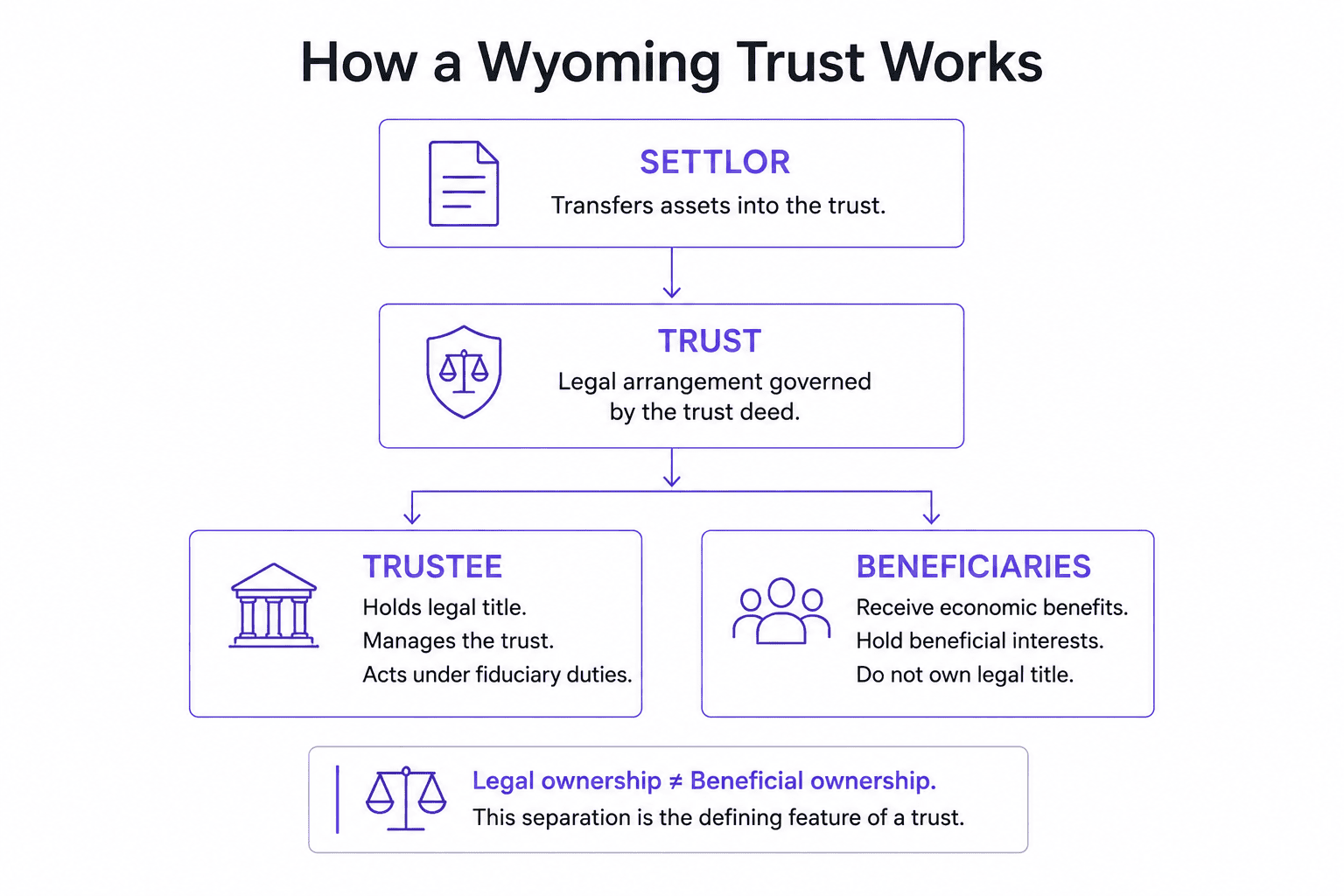
The settlor (the person who creates the trust) transfers legal title to a trustee. The trustee then has a fiduciary duty to manage the trust property for the beneficiaries. A trust has no shareholders, and nobody owns “shares” in it. Instead, the trustee holds legal title, while the beneficiaries hold the beneficial interest. This split between legal ownership and beneficial enjoyment is what makes a trust different from an LLC. It allows a trust to preserve wealth across generations and separate control from enjoyment. It also creates a legal barrier between trust assets and claims against the settlor.
The Basics of Wyoming Trusts
The Wyoming Uniform Trust Code provides the legal framework for these arrangements. It sets out how trusts are created, administered, modified, and terminated. It also defines the rights and duties of settlors, trustees, and beneficiaries, including when a trustee may be held liable for breaching fiduciary duties. Several provisions of the Code also explain why founders often choose Wyoming over many other U.S. states
No State Income Tax
Wyoming charges no state income tax on retained trust income.
Flexible Control
A settlor may keep meaningful investment powers without automatically losing asset protection.
1,000-Year Trusts
Wyoming allows trusts to continue for up to 1,000 years.
Founders use these three features to solve three different problems:
- shielding personal wealth from a lawsuit filed in a different state,
- building a succession plan that survives several generations of beneficiaries,
- and stopping a high-tax home state from taxing trust income that has no real connection to that state.
Wyoming also allows non-charitable purpose trusts, although many states prohibit or restrict them. These trusts exist to achieve a specific purpose rather than benefit a named person. They may, for example, hold a family aircraft or fund litigation. Because there is no beneficiary to oversee the trustee, the trust instrument usually appoints a trust protector or trust advisor. Otherwise, a court may appoint someone to perform that role.
Trust property may be used only for its stated purpose. If a court later finds the trust holds more property than necessary, the surplus returns to the settlor or the settlor’s successors. Wyoming also rejects the common-law rules that limit how long these trusts may last. They can continue indefinitely, which makes Wyoming a practical choice for founders with niche or illiquid assets.
I. The Main Types of Wyoming Trusts
Wyoming does not sell five separate trust products. It offers one statute, the Wyoming Uniform Trust Code. On top of that statute sit several elections and drafting choices. Some of the names below are real, separate trusts. Others are just a feature you add to a trust you already built. Knowing the difference now will save you confusion later. Otherwise, a trust you already understand will look brand new halfway through this guide. It is really the same trust with a new label.
First Fork: Revocable vs. Irrevocable
Before you look at the five structures below, you face a bigger choice: revocable or irrevocable. This one decision decides whether your trust protects anything at all.
What a Revocable Trust Does Not Protect
A settlor can undo a revocable trust at any time, for any reason. Wyoming law is blunt about what that means for creditors. Wyoming Statute § 4-10-506 says the property in a revocable trust stays open to the settlor’s creditors for the settlor’s whole life. A revocable trust is a tool for probate and administration. It moves assets outside your will, keeps them out of public probate records and lets a successor trustee step in without a court case if you become incapacitated. None of that protects your assets. It was never built to.
Why This Mistake Costs People So Much
This is where a lot of damage happens. The law is rarely the problem. Estate planning talks tend to focus on probate and incapacity. Both are real benefits. But nobody asks about creditor protection. Many founders set up a revocable trust and assume it also protects their assets. That assumption often goes uncorrected. They learn the truth from a second advisor, after the fact. By then a claim may already exist, and the timing is fixed. Converting the trust, or funding a Qualified Spendthrift Trust instead, cannot undo that. A transfer made after a lawsuit starts is exactly the kind of transfer a court can unwind. So is a transfer made once the settlor already expects a lawsuit. You will read more about those fraudulent transfer rules later in this guide. The fix has to happen while the water is calm. It cannot happen once the storm starts. Every structure below assumes you already made the irrevocable choice, and made it for the right reason.
1. Qualified Spendthrift Trust (QST)
This is the base asset-protection trust. Most of this guide is built around it. A settlor funds an irrevocable trust. The settlor can still act as investment advisor and stay a discretionary beneficiary. The assets stay out of reach of creditors, as long as the trust meets the conditions in Wyoming Statute § 4-10-510. Consider this trust if you want to separate your wealth from a lawsuit without losing all access to your money.
Founders seeking strong domestic asset protection while remaining a discretionary beneficiary.
2. Directed Trust
This is not a separate trust. A directed trust is a governance choice you add to a QST, or to any Wyoming trust. It splits investment authority from day-to-day administration. Wyoming Statute § 4-10-718 lets a trust advisor direct investment decisions. A Wyoming trustee still handles compliance and records.
Founders who want to keep a say over investment decisions while leaving administration and compliance to a Wyoming trustee.
3. Wyoming Incomplete Gift Non-Grantor Trust (WING)
A WING is a Qualified Spendthrift Trust. It is drafted to fail the federal grantor trust tests under IRC §§ 671–679. That means the trust itself pays tax, not the settlor. Consider this option before a big liquidity event, like selling a business or a large stock position. It works best if you live in a state that taxes trust income and want that income taxed in Wyoming instead.
Founders who expect to sell a business or another highly appreciated asset while living in a high-tax state.
4. Dynasty structuring
This is also not a separate trust. Wyoming dropped the old rule against perpetuities for trusts made after July 1, 2003. Under Wyoming Statute § 34-1-139, a trust can now last up to 1,000 years instead of the old 21-year limit. Consider building this into a QST if you want to hold wealth across several generations, rather than hand it all to your children outright.
Families planning to preserve wealth across multiple generations.
5. Non-Charitable Purpose Trust
This one is truly different from the four above. It has no beneficiary at all. Wyoming Statute § 4-10-410 lets a trust exist to fund one specific purpose. A trust protector or a court enforces it, not a person with a claim on the assets. Consider it for holding an asset that needs no human beneficiary: an aircraft, an art collection, or shares in a holding company.
Holding assets or funding a specific long-term purpose without naming beneficiaries.
Each one gets its own section later in this guide. We start with the Qualified Spendthrift Trust. The directed trust, the WING, and dynasty structuring are all built on top of it.
There is a second fork worth knowing, now that you have seen the five structures above: Grantor vs. non-grantor.
Second Fork: Grantor vs. Non-Grantor
This one has nothing to do with creditor protection. It decides who owes the income tax.
How the IRS Tells the Two Apart
Under 26 U.S. Code § 671 and the sections after it, a trust is a “grantor trust” if the settlor keeps certain powers over it, such as the power to revoke or the right to receive its income. When that happens, the IRS ignores the trust for income tax purposes and taxes everything directly on the settlor’s own return, at the settlor’s own rates. A “non-grantor trust” gives up those powers. It becomes its own taxpayer, files its own return, and pays tax on whatever income it keeps, under the compressed brackets covered later in this guide.
A revocable trust is always a grantor trust. Keeping the power to revoke is one of the triggers, so the two forks connect: a revocable trust gives you neither creditor protection nor a separate taxpayer to shift income into. A QST can be drafted either way. A WING cannot. It only works as a non-grantor trust, since the entire point is moving the tax bill off the settlor’s personal return.
II. The Trust Triangle and How Wyoming Rewires It
Every trust has three core parties, often called the trust triangle:
Settlor
Creates the trust and transfers property into it.
Trustee
Holds legal title and administers the trust property.
Beneficiary
Holds a present or future beneficial interest in the trust.
Directed Trusts and Trust Advisors
In most states, the trustee performs all fiduciary duties and makes all major decisions. Wyoming allows a different approach through its directed trust statute. The trust may appoint a trust advisor to direct the trustee on specific matters, including whether to retain, purchase, sell, exchange, or tender trust property. When the trustee follows those directions, Wyoming law treats the trustee as an excluded fiduciary. The trustee is generally not liable for losses that result from following the advisor’s instructions. Instead, that responsibility shifts to the trust advisor unless the trust instrument provides otherwise.
The Role of the Trust Protector
A trust protector has a different role. This independent third party may amend the trust, review the trustee’s actions, or direct distributions. The trust protector may also respond to changes in tax or trust law. Like the trustee and other fiduciaries acting under the trust, a trust protector submits to the jurisdiction of Wyoming courts upon accepting the appointment, even if they live outside the state.
Why Directed Trusts Matter
This structure also solves a common problem. Many settlors do not want a professional trustee to control investment decisions. However, if they keep that control, the trust may lose some of its protection. A directed trust separates those roles. As a result, the settlor may serve as the investment advisor. The Wyoming trust company then manages the trust, handles distributions, and takes care of compliance.
Qualified beneficiaries also retain an important safeguard. They may remove the trust advisor by unanimous written consent. Once the trustee receives that notice, the trustee no longer has a duty to follow that advisor’s future directions.
This control has a cost outside the United States. Keeping a real say over investments is exactly the kind of power many foreign tax authorities treat as a red flag. Civil-law countries in particular apply a look-through, or “interposed trust,” test. If the settlor keeps enough control over how the trust invests or distributes money, the settlor’s home country may disregard the trust completely. It then taxes the settlor as if they still own the assets directly. Italy’s tax authority applied exactly this reasoning in March 2026, disregarding a trust where the settlor’s day-to-day control looked too close to ownership. A directed trust stays fully valid under Wyoming law either way. But a settlor whose home country applies this test may get none of the protection the structure is meant to provide, once their own government decides who is really pulling the strings. Check how the settlor’s home country treats a foreign trust with a settlor-controlled investment advisor before choosing this structure for that reason alone.
III. Asset Protection: The Qualified Spendthrift Trust
Most U.S. states do not let a settlor protect their own assets from their own creditors. If the settlor funds a trust and also names themselves as a beneficiary, the trust is usually treated as self-settled. In most states, creditors may reach those assets because the settlor still benefits from them.
Wyoming takes a different approach. Its Qualified Spendthrift Trust statute allows a settlor to fund the trust, act as the investment advisor, and remain a discretionary beneficiary. Even so, creditors generally cannot reach the trust assets if the trust meets the statutory requirements.
Qualified Spendthrift Trust Requirements
Under Wyoming Statute § 4-10-510, a trust qualifies as a Qualified Spendthrift Trust only if it satisfies all five of the following conditions:
- The trust is irrevocable.
- The trust instrument expressly states that it is a Qualified Spendthrift Trust governed by Wyoming law.
- Wyoming law governs the trust’s validity, construction, and administration.
- The trust instrument contains a valid spendthrift provision.
- At least one qualified trustee performs real administrative functions in Wyoming.
Powers the Settlor May Retain
The statute does not require the settlor to give up all control. For example, the settlor may veto distributions, hold a lifetime or testamentary power of appointment, and receive up to five percent of the trust’s initial value each year. The settlor may also receive income from a charitable remainder unitrust or annuity trust held by the trust.
However, the settlor cannot control who else benefits from the trust or revoke it at will. Retaining economic benefits is not the key issue. Retaining control over beneficial enjoyment is.
The Qualified Transfer Affidavit
Funding a Wyoming Qualified Spendthrift Trust is not a one-time event. Each transfer into the trust is treated separately. Under Section 4-10-523, the settlor must sign a Qualified Transfer Affidavit for every transfer. If the settlor fails to do so, that transfer alone loses asset protection. The rest of the trust remains protected. A later affidavit does not fix the earlier transfer. It also does not restart the period during which a creditor may challenge that transfer.
The affidavit is a sworn statement. In it, the settlor makes six declarations:
Qualified Transfer Affidavit
- The settlor owns the transferred property.
- The transfer will not make the settlor insolvent.
- The transfer is not intended to defraud creditors.
- No pending litigation threatens solvency.
- No overdue child support is owed.
- The settlor maintains at least $1 million of liability insurance.
There are only two exceptions. The affidavit is not required for trusts created by court order or for irrevocable income trusts established under federal Medicaid rules. As a result, a founder who transfers assets into a Wyoming trust over time should expect to sign and keep a separate affidavit for each transfer.
Discretionary and Mandatory Distributions
Wyoming protects trust assets by limiting what a creditor can claim. It does not rely on secrecy. Even so, a private Wyoming trust is not filed with the State or recorded in a public register. As a result, it offers a high level of privacy.
In a discretionary trust, the trustee decides whether to make a distribution. In a mandatory trust, the trustee must make a distribution when the trust sets a specific condition, such as a beneficiary reaching a certain age.
Creditor Rights Against Trust Distributions
Section 4-10-504 protects both types of trusts. A creditor cannot force the trustee to make a discretionary distribution. A creditor also cannot force a mandatory distribution or sue the trustee for refusing to make one.
Until the trustee makes a distribution, the beneficiary has no property to receive. As a result, the creditor has nothing to seize. For example, if a beneficiary is facing a lawsuit, the trustee may delay the distribution. Keeping the assets in the trust also keeps them out of the creditor’s reach.
IV. Where the Wyoming Shield Actually Ends
A Wyoming Qualified Spendthrift Trust does not protect against every claim. Before using one, founders should understand its limits.
Time Limits on Creditor Claims
Time limits are one example. If the trust was revocable when the settlor died, creditors generally have two years to bring a claim. Wyoming law allows that period to end sooner. If the trustee publishes notice once a week for two consecutive weeks in a newspaper of general circulation, creditors have 120 days to file a claim. A known creditor who receives notice by certified mail also has 120 days from the mailing date. A creditor who misses the deadline cannot reach the trust.
Different rules apply while the settlor is alive. A creditor who challenges a transfer must sue under the Uniform Fraudulent Transfer Act. The creditor must prove, by clear and convincing evidence, that the settlor transferred the property with actual or constructive intent to defraud. Courts consider several factors. For example, they look at whether the settlor was already facing a lawsuit, transferred most of their assets, or became insolvent after the transfer. The claim must be filed within four years of the transfer or within one year after the creditor discovered, or reasonably should have discovered, it. Even then, the court may set aside the transfer only to the extent needed to satisfy that creditor’s claim.
Creditors Who Can Reach the Trust
Some creditors have broader rights. A creditor with child support that is more than 30 days overdue may attach trust property directly. The same rule applies if the settlor used trust property to secure a loan on a credit application. By contrast, Belize international trusts generally do not carve out either exception. Belize repealed the fraudulent-conveyance challenge entirely and blocks foreign judgments tied to insolvency, divorce, or succession claims, leaving proven fraud in forming the trust as close to the only way a creditor gets in.
Bankruptcy Claims
Federal bankruptcy law also limits Wyoming’s protection. State law does not control bankruptcy proceedings. Under Section 548(e) of the Bankruptcy Code, a bankruptcy trustee may recover property transferred to a self-settled trust within ten years before the bankruptcy filing. The trustee must prove that the transfer was made with actual intent to hinder, delay, or defraud a creditor. This rule applies to all U.S. domestic asset protection trusts, including those formed in Wyoming.
Foreign Judgments
Foreign judgments follow a separate rule. A judgment from another jurisdiction is not automatically enforceable against a Wyoming trust. Under Section 4-10-507.1, a Wyoming court must first decide whether the judgment complies with Wyoming’s creditor-protection rules. In addition, if a foreign court refuses to apply Wyoming law, the Wyoming trustee may resign without a court order. The trust then remains without a trustee until a successor is appointed.
Stacking an LLC Charging Order on Top
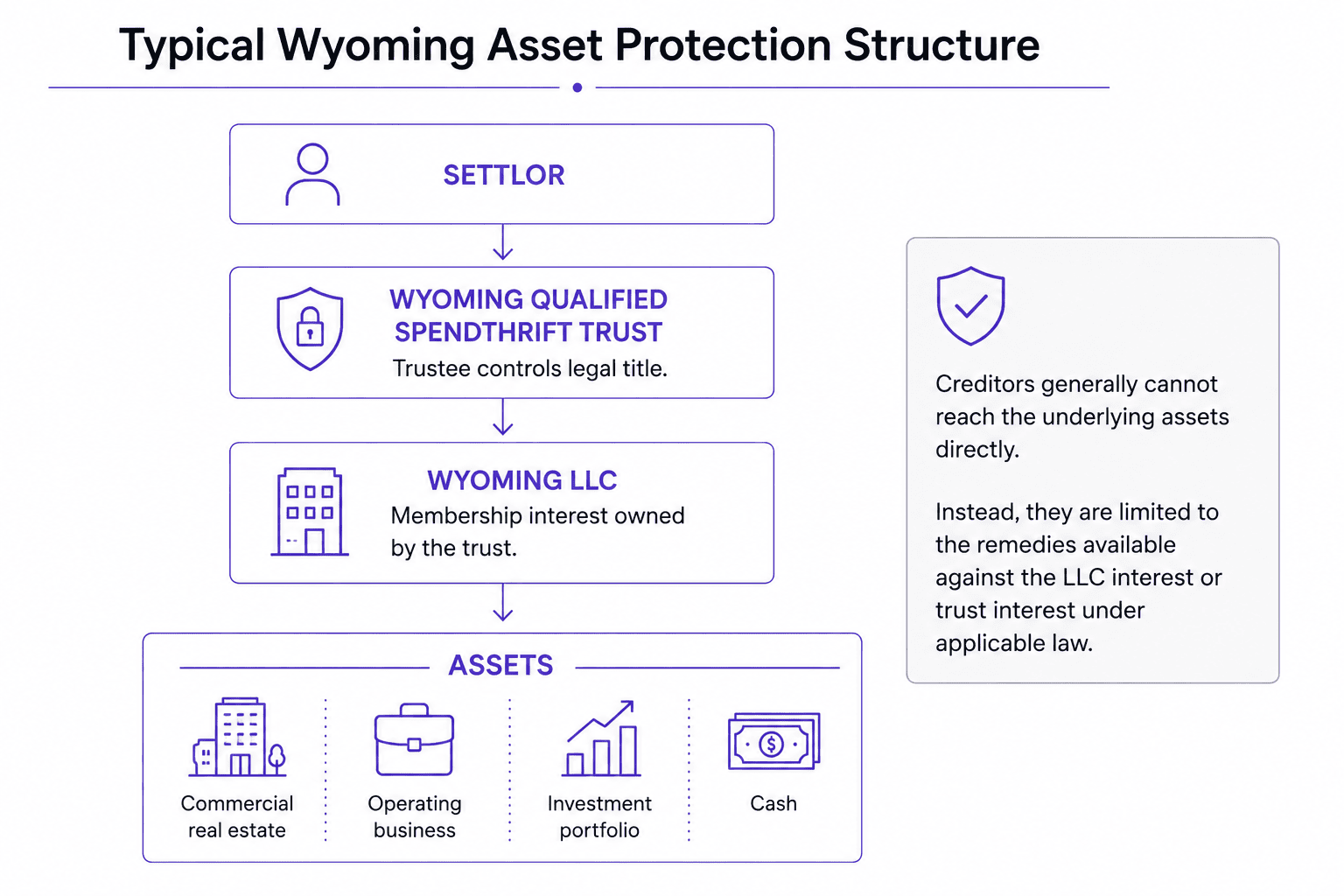
Wyoming founders often combine a trust with a Wyoming LLC instead of relying on the trust alone. The trust owns the LLC membership interest, while the LLC owns the underlying assets, such as real estate, an operating business, or a brokerage account.
The Wyoming LLC Act limits a creditor to a charging order. This is the creditor’s exclusive remedy against a member’s interest. The creditor may receive a lien on future distributions, but nothing more. The creditor cannot foreclose on the membership interest, force a distribution, or exercise voting or management rights.
This structure also has practical value. Because the trustee controls the LLC, the trustee may decide not to make a distribution. As a result, the creditor holds a lien but receives no payment. In some cases, the IRS may still tax the creditor on phantom income allocated to that lien.
Colorado follows a different approach. A creditor may foreclose on a single-member LLC interest and use reverse veil piercing to reach the LLC’s assets. Wyoming law does not allow reverse veil piercing. As a result, creditors are often more willing to settle than litigate when a Wyoming trust and LLC are used together.
V. How Wyoming Taxes, and Does Not Tax, Trust Income
A trust does not eliminate tax. However, it can change where some tax is paid. One of Wyoming’s main advantages is that it does not impose several state taxes.
Wyoming State Taxes
The State has no state income tax, estate tax, gift tax, or capital gains tax. As a result, a trust administered in Wyoming pays no Wyoming tax on income it keeps. This can benefit settlors who live in states with higher trust taxes.
Colorado is one example. It taxes resident trusts administered in the state and non-resident trusts with Colorado-source income. A settlor may reduce that state tax by moving the trust to Wyoming. This usually requires appointing a Wyoming trustee, removing the previous trustee, transferring the trust’s administration to Wyoming, and amending the trust to choose Wyoming law.
Federal Income Tax
Federal tax still applies. Where the trust is administered does not change that.
The Internal Revenue Code taxes retained income in a non-grantor trust at much lower thresholds than it does for individuals. For the 2026 tax year, a non-grantor trust reaches the top 37% federal tax bracket after more than $16,000 of retained income. These thresholds are adjusted for inflation under IRS Revenue Procedure 2025-32. By comparison, a single individual does not reach the 37% bracket until taxable income exceeds $640,600.
Retained investment income above $16,000 is also subject to the 3.8% Net Investment Income Tax. Together, these taxes create a top federal rate of 40.8% on retained trust income.
Simple Trusts and Complex Trusts
The WING Trust: Deferring State Tax Before a Liquidity Event
Founders who expect to sell a highly appreciated asset often use a Wyoming Incomplete Gift Non-Grantor Trust (WING), especially if they live in a high-tax state. A WING is a Qualified Spendthrift Trust designed to avoid grantor trust status under Section 673 of the Internal Revenue Code. If structured successfully, the trust is treated as a non-grantor trust, so its income is generally not attributed to the settlor for income tax purposes. If the trust becomes a grantor trust, the IRS ignores it for income tax purposes. In that case, the trust income is taxed to the settlor under the tax laws of the settlor’s home state.
How a WING Trust Works
To remain a non-grantor trust, the settlor must avoid several conditions. The settlor cannot keep a reversionary interest worth more than five percent of the trust’s initial value. The settlor also cannot control who benefits from the trust, revoke the trust, receive unauthorized distributions, or leave the trust assets exposed to personal creditors.
A WING uses a distribution committee to limit the settlor’s control. The committee consists of beneficiaries with a substantial adverse interest in the trust property. The committee must approve any distribution to the settlor. Because the settlor cannot withdraw trust assets on their own, the IRS treats the initial transfer as an incomplete gift rather than a completed gift. The trust files its own tax return, and the income remains outside the settlor’s home-state income tax system until the committee approves a distribution.
VI. Banking a Wyoming Trust
KYC and AML Requirements
A Wyoming trust needs a bank account to operate. Opening that account subjects the trust to the same anti-money laundering rules that apply to other U.S. bank accounts. Under the Bank Secrecy Act, banks must complete Know Your Customer (KYC) and Anti-Money Laundering (AML) checks before opening the account.
Banks usually ask for a certification of trust, an Employer Identification Number (EIN), and government-issued identification for the trustee. They also require beneficial ownership information that identifies the natural persons who control the trust.
Banks generally require information about the trustee and other individuals who exercise control over the trust. Depending on the trust structure and the bank’s AML procedures, they may also request information about the settlor, protector, or beneficiaries.
Wyoming Banking Requirements
The deposits must be insured by a federal agency. Institutional trustees have additional responsibilities. They must file Suspicious Activity Reports when required and screen transactions against the Office of Foreign Assets Control (OFAC) sanctions list. In practice, many trustees also reject trusts with opaque foreign beneficiaries, high-risk offshore counterparties, or funds that cannot be traced to a legitimate source.
Certification of Trust
A trustee does not need to give the bank a copy of the full trust instrument. Instead, Section 4-10-1014 allows the trustee to provide a Certification of Trust. The certification confirms that the trust exists, identifies the settlor and acting trustee, and states whether the trust is revocable. It also describes the trustee’s administrative powers and explains how title to the trust property is held.
The certification does not disclose the trust’s dispositive terms. It does not identify the beneficiaries or explain how trust assets will be distributed. Finally, it must confirm that the trust has not been revoked or amended in a way that makes the certification inaccurate.
VII. The Compliance Stack: Privacy, FinCEN, and Beneficiary Notice
Trust Privacy Under Wyoming Law
Wyoming does not require a non-charitable trust to register with a court or public registry. As a result, the trust’s existence and terms remain private by default.
However, trustees still have legal duties. They must keep trust property separate from their own property. In addition, supervised trust companies must permanently keep their capital stock ledgers, minute books, and accounting records.
The Corporate Transparency Act
Federal beneficial ownership reporting has changed several times in recent years. As a result, outdated guidance remains a common source of confusion.
The Corporate Transparency Act originally required many domestic entities and certain trusts to file Beneficial Ownership Information (BOI) reports with FinCEN. On March 21, 2025, FinCEN issued an interim final rule that changed the definition of a reporting company. Under that rule, only foreign entities registered to do business in the United States must file BOI reports. Domestic entities and U.S. persons are no longer subject to that requirement.
A Wyoming trust is generally outside the BOI reporting regime under the current rule. The trustee’s nationality or residence does not, by itself, determine whether a BOI filing is required. It does not file an initial BOI report. If it filed a report before the rule changed, it does not need to update it.
U.S. persons who are beneficial owners of foreign reporting companies are also exempt. Foreign entities remain subject to the reporting rules. Those that register after March 26, 2025, must file a BOI report within 30 calendar days of their effective registration.
Why the Exemption May Change
The current exemption is based on an interim final rule rather than a final rule. FinCEN submitted a final rule to the Office of Management and Budget on June 5, 2026, for review. Until that rule takes effect, the current exemption remains in force but may change.
For that reason, trustees should confirm the current reporting requirements before assuming that a Wyoming trust is permanently exempt from BOI reporting.
Residential Real Estate Reporting: Currently Vacated, Not Currently Live
FinCEN also adopted a reporting rule for certain residential real estate transactions involving trusts and legal entities. The rule took effect on March 1, 2026, under the Bank Secrecy Act.
The rule applied only if four conditions were met:
- The property was residential, such as a one-to-four family home, a condominium, or vacant land intended for residential use.
- The purchase was non-financed and did not involve credit from an AML-regulated lender.
- The property was transferred to a trust or legal entity.
- No exemption applied.
Under that rule, if a Wyoming trust bought residential property with cash, the title company, closing agent, or real estate attorney would file a Real Estate Report with FinCEN. The report was due within 30 days of closing or by the end of the following month, whichever was later. The trustee did not file the report. However, the trustee had to provide the settlor’s and beneficiaries’ information to the reporting person.
Current Status of the Rule
The rule is not currently in force. On March 19, 2026, the U.S. District Court for the Eastern District of Texas vacated the Residential Real Estate Rule, holding that FinCEN exceeded its authority under the Bank Secrecy Act.
FinCEN now states that reporting persons do not have to file Real Estate Reports while that decision remains in effect. They also face no liability for failing to file during that period.
The litigation is not over. The Department of Justice has appealed the decision, and several other cases challenging the rule remain pending in federal court.
For now, a Wyoming trust that buys residential real estate has no federal reporting obligation under this rule. However, trustees should monitor future developments because the reporting requirement could return if the appeal succeeds.
Quiet Trusts
Most states follow Section 813 of the Uniform Trust Code. Under that rule, a trustee must tell qualified beneficiaries who are at least 25 years old that the trust exists. The trustee must also provide annual trust accountings.
Wyoming follows a different approach. Section 4-10-105 allows a settlor to create a quiet trust. The trust instrument may waive the trustee’s duty to disclose the trust’s assets, liabilities, receipts, and disbursements to beneficiaries.
Beneficiary Notice
A trustee of a quiet trust does not send beneficiaries bank statements or tax returns. Settlors often use this structure to delay disclosure until beneficiaries are better prepared to manage the information. It may also reduce disputes over investment decisions while the trust is still being administered.
However, the trustee’s duty to give notice does not disappear completely. The trustee must still notify any beneficiary whose identity and location are known or can be determined. A beneficiary who is entitled to notice may also waive that right in writing.
VIII. Private Trust Companies
Family-Owned Trustee Companies
Some families prefer to keep control of the trustee instead of appointing an outside trust company. Wyoming allows this through a Private Trust Company (PTC). A PTC is formed as a Wyoming LLC or corporation and serves as trustee only for trusts created by one family. It cannot provide trustee services to the public.
Chartered and Unregulated PTCs
Wyoming recognizes two types of PTCs.
A chartered PTC must obtain a charter from the Wyoming Banking Commissioner. It must maintain at least $500,000 in capital, excluding organizational expenses. It must also keep a physical office in Wyoming, maintain its business records there, and hold a bank account with a Wyoming state or national bank. The Wyoming Banking Commissioner examines the company on a regular basis. A chartered PTC may serve family members related to as many as two designated relatives, allowing it to support a larger extended family.
An unregulated private family trust company does not need a charter. It also avoids the capitalization requirement and routine examinations. However, it may serve only the relatives of one designated relative. Unlike a chartered PTC, the identity of that designated relative remains part of the company’s private records.
Choosing Between the Two
Neither type of PTC may provide trustee services to the general public. Both exist only to serve one family’s trusts.
The main difference is the level of regulation. Larger families often choose a chartered PTC because banks and other institutions may place more confidence in a regulated trustee. Smaller families may prefer an unregulated PTC because it avoids the $500,000 capital requirement and ongoing regulatory examinations.
IX. Dynasty Trusts: Perpetuity, Decanting, and Amendment
Wyoming’s 1,000-Year Trust Period
Under the traditional Rule Against Perpetuities, a trust generally ends 21 years after the death of a person who was alive when the trust was created. Wyoming changed that rule for trusts created after July 1, 2003. Under Section 34-1-139, a Wyoming trust may continue for up to 1,000 years.
However, this rule applies only to personal property, such as shares in a company, cash, or investment portfolios. Real property, meaning land and buildings, held directly by the trust remains subject to the common law Rule Against Perpetuities.
Many families avoid this limit by placing the real estate into a Wyoming LLC. The trust then owns the LLC membership interest instead of the real estate. Because an LLC membership interest is personal property, the trust may hold it for the full 1,000-year period.
Decanting a Trust
A long-term trust must be able to adapt as tax laws and family circumstances change. Wyoming allows trustees to do this through decanting.
Decanting allows a trustee to transfer trust assets into a new trust with updated terms. Section 4-10-816 gives this authority to a trustee who has mandatory or discretionary distribution powers. A trustee who acts in good faith is generally protected from liability for that decision.
The power is not unlimited. A trustee may not use decanting to eliminate a federal estate tax deduction, a marital deduction, a charitable deduction, or a generation-skipping transfer tax exemption that applies to the original trust. A trustee also may not use decanting to increase the trustee’s own beneficial interest.
Nonjudicial Settlement Agreements
Wyoming also allows interested parties to modify certain trust matters without going to court.
Under Section 4-10-111, the settlor, trustee, trust protector, and qualified beneficiaries may enter into a nonjudicial settlement agreement. The agreement may interpret trust provisions, approve a trustee’s accounting, appoint a successor trustee, set trustee compensation, change the trust’s principal place of administration, or convert an existing trust into a Wyoming Qualified Spendthrift Trust.
The agreement cannot defeat a material purpose of the original trust. In addition, any interested person may ask a court to confirm that the agreement contains terms the court could have approved.
X. Ending or Moving a Wyoming Trust
When a Trust Ends
Every trust eventually comes to an end. In Wyoming, a trust may terminate under its own terms. It may also end if its purpose becomes unlawful, impossible to achieve, or has already been fulfilled.
Wyoming also provides a simplified process for small trusts. Under Section 4-10-415, a trustee may terminate a trust without a court order if its fair market value is less than $150,000.
Before doing so, the trustee must prepare a distribution plan that is consistent with the trust’s purpose. The trustee must also give written notice to every qualified beneficiary. If no beneficiary objects in writing within 30 days, the trustee may distribute the trust property and close the trust. If a beneficiary objects, the trustee must ask the court for authority to terminate the trust.
Final Distribution
When a trust ends, the trustee distributes the remaining trust property to the beneficiaries. Before making the final distribution, the trustee may keep a reasonable reserve to pay outstanding debts, administrative expenses, and taxes.
The trustee must also provide beneficiaries with a proposed distribution. A beneficiary generally has 30 days to object after receiving the notice, provided the notice clearly states that deadline.
The trustee may also ask the beneficiaries to sign a release of liability. However, a release is not effective if the trustee obtained it through improper conduct or if the beneficiary signed without knowing about a breach of trust or their legal rights.
Moving a Trust to Another Jurisdiction
Sometimes a settlor wants to move a trust instead of terminating it. In that case, the existing trustee resigns and a successor trustee in the new jurisdiction takes office. The parties may then enter into a nonjudicial settlement agreement to change the trust’s principal place of administration.
XI. Frequently Asked Questions (FAQs)
Creating a Wyoming Trust
Does a non-U.S. citizen need to be a U.S. resident to create a Wyoming trust?
No. A foreign settlor can create and fund a Wyoming trust. For certain Wyoming trust structures, the law requires a qualified trustee performing real administrative work in Wyoming, but the settlor does not need to be a U.S. resident.
Can I be my own trustee and still get asset protection?
No. A Qualified Spendthrift Trust must appoint a qualified trustee under Section 4-10-510. Although the settlor may retain certain powers, including serving as investment advisor, the trust must continue to satisfy the statutory qualified trustee requirements to receive Wyoming’s asset protection.
Asset Protection and Estate Planning
Does a Wyoming trust protect assets in a divorce?
Not automatically. Divorce is governed by family law rather than the creditor-protection rules discussed in this guide. Whether trust assets are included in a divorce depends on the governing state’s marital property laws and the facts of the case, including when the trust was funded, whether the settlor retained significant control, and whether the assets are treated as marital property.
Does a Wyoming trust replace a will?
No, and treating it as a substitute is a common and expensive mistake. A trust only controls the property actually transferred into it. Anything left in the settlor’s individual name at death passes through probate under a will, or under state intestacy law if there is no will, regardless of how well-drafted the trust is.
Is a revocable living trust protected the same way as a Qualified Spendthrift Trust?
No. A revocable trust can be undone by the settlor at any time, which is exactly why creditors can reach it: the settlor’s continuing control over the assets means the assets are still, in substance, the settlor’s. The asset protection discussed throughout this guide applies only to an irrevocable trust drafted to meet the specific requirements of Section 4-10-510.
Moving After the Trust Is Created
If I move away from Wyoming after creating the trust, does the trust stay valid?
Yes. The trust’s governing law is set by the instrument itself, not by where the settlor happens to live. What matters for the Qualified Spendthrift Trust’s protection is that the qualified trustee continues performing real administrative work inside Wyoming, regardless of where the settlor relocates.
⚠️ DISCLAIMER
The information in this article is for general guidance only and does not constitute legal, tax, or financial advice. Wyoming trust law, federal tax thresholds, and FinCEN’s beneficial ownership and residential real estate reporting rules are all subject to change, and the residential real estate reporting rule in particular is currently under active litigation. Laws and regulations cited reflect the landscape as of August 1, 2026. Always consult a qualified Wyoming trust attorney and a tax professional before creating or funding a trust.

Korporatio – first mover in Wyoming enabling real-world companies
Find out what our newest jurisdiction in Wyoming means to businesses.
0 Comments10 Minutes

Why Choose a Wyoming LLC?
Trusted, agile and cost-effective. Learn more why set up a company here!
0 Comments14 Minutes

Wyoming LLC Tax and Accounting Requirements for U.S. Citizens in 2026
Wyoming accounting requirements for LLCs for US residents.
0 Comments61 Minutes